
Several international programmes aim to replicate the only successful eradication precedent for other diseases, but the midterm review of the WHO 2021–2030 roadmap shows that neither of the targeted eradication programmes—dracunculiasis and yaws—is on track. Understanding what disease eradication means requires clearly distinguishing it from national elimination, a distinction often blurred in health communications.
Global eradication and national elimination: two distinct public health realities
Eradication means the permanent reduction of a disease’s global incidence to zero, with no further control measures required. Elimination, by contrast, applies to a specific territory: a country can be certified as free of a disease even while transmission continues elsewhere. For a closer look at these concepts, the definition of disease eradication provides a precise framework.
Suriname illustrates the distinction. The WHO certified the country as malaria-free in 2025, thanks to stronger health systems and sustained regional cooperation. This national achievement does not change the global picture: malaria is still circulating in dozens of countries, and estimated cases in the Americas rose in 2024 compared with the previous year, according to the Pan American Health Organization (PAHO).
When a government announces a “victory” over a disease, it almost always refers to local elimination. Global eradication requires transmission to be interrupted everywhere, simultaneously and sustainably. This distinction is far from academic: it determines whether surveillance and vaccination programmes can be scaled back.
Polio: why eradication is slipping despite vaccination
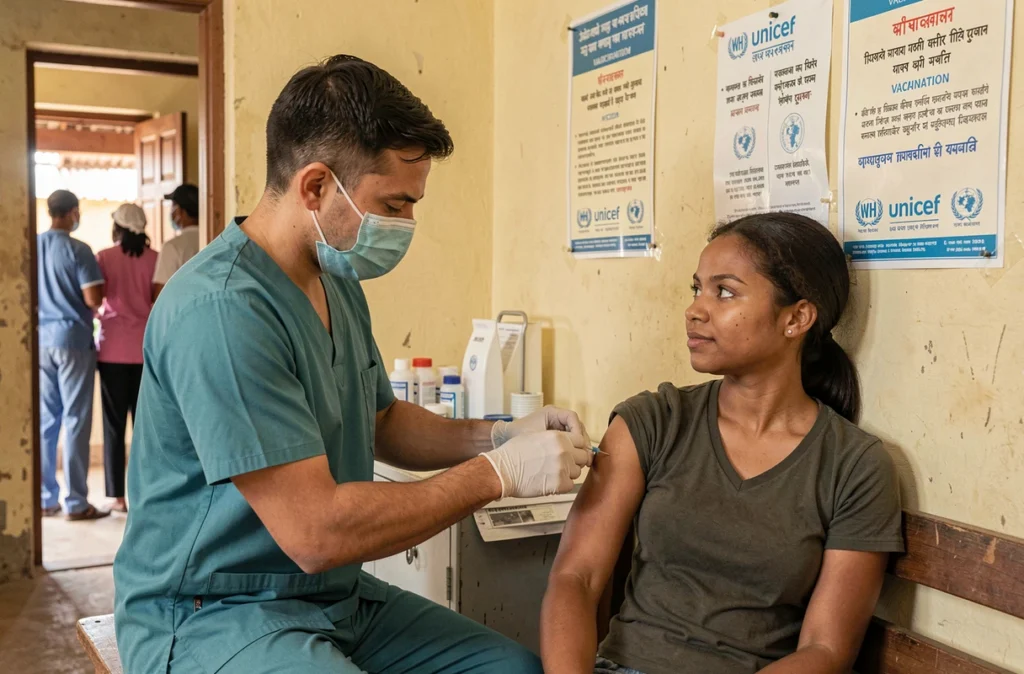
Polio is the clearest example of an eradication programme stalled by its final obstacles. In 2025, wild poliovirus transmission persisted in Afghanistan and Pakistan. At the same time, outbreaks of variant poliovirus were circulating in 17 countries and territories.
The reasons for this impasse are both operational and political:
- Armed conflicts and population displacement prevent vaccination teams from reaching some areas, creating pockets of low immunisation where the virus can persist.
- Funding constraints limit epidemiological surveillance capacity, particularly routine sequencing of circulating strains, which makes it possible to trace transmission chains.
- Community trust in vaccination campaigns cannot be taken for granted everywhere, and cases of incomplete or falsified vaccination records have made it harder to track actual coverage.
These challenges show that having a vaccine available is not enough to guarantee eradication. The quality of implementation, public acceptance and continuity of funding matter just as much as the vaccine itself.
Neglected tropical diseases: eradication targets are falling behind
The WHO 2021–2030 roadmap on neglected tropical diseases set ambitious targets, including eradicating dracunculiasis (Guinea worm disease) and yaws. The midterm review is unequivocal: neither programme is on the planned trajectory.
Dracunculiasis cases have fallen dramatically since the 1980s, but the last remaining foci persist. Animal transmission, particularly among dogs, complicates a programme originally designed to interrupt a transmission chain involving humans alone. Yaws, another eradication target in the roadmap, is also significantly behind schedule because mass treatment campaigns have not been extensive enough.
These delays raise a fundamental question about the eradication strategy itself. The resources required to achieve “zero cases worldwide” are considerable. When a programme stagnates for years in its final stages, the international health community faces a trade-off: maintain the eradication goal or redirect resources towards sustained control.
The role of cross-border cooperation
Malaria elimination in a country such as Suriname was possible only through active regional cooperation. Without cross-border coordination, a country certified as disease-free remains vulnerable to reintroduction through population movements from neighbouring areas where the disease is still endemic.
PAHO emphasises this point in the Americas, where countries are strengthening their shared commitments to malaria elimination and border surveillance. The same principle applies to every communicable disease: eradication is a collective effort, or it is not eradication at all.

Budget cuts and the risk of disease resurgence
The WHO has warned that diseases that are largely under control could re-emerge as a result of funding cuts. This risk is not limited to neglected tropical diseases: it also affects routine vaccination programmes against illnesses such as measles and diphtheria.
The mechanism is straightforward. When vaccination coverage in a population falls below a certain threshold, herd immunity weakens and outbreaks become possible again, including in countries that eliminated the disease years ago. Elimination is never permanent without ongoing funding for surveillance.
For eradication programmes currently underway, budget cuts have an amplified effect. Every year of delay in interrupting transmission increases the programme’s total cost and the risk of the virus or parasite gaining ground again. The history of polio shows this clearly: gains made over several decades can be undermined within months if vaccination campaigns are interrupted.
Disease eradication remains an unparalleled public health goal, but current programmes are a reminder that the gap between national elimination and global eradication is measured in decades, billions and sustained political will. Victory announcements should be viewed in this light: as long as transmission persists somewhere, the countdown has not begun.