Supporting a child day to day takes time, energy and resources that not all households have in equal measure. Advice on calm parenting often assumes ideal circumstances: two available parents, a comfortable budget and a support network nearby. When one of these is missing, the promised peace of mind can quickly become yet another demand.
Family responsibilities and support: what parenting advice leaves out
Most parenting guides address one parent alone with the child, as if the difficulty lay solely in the parent-child relationship. How tasks are actually shared between the adults in the household is rarely discussed.
The instruction of 6 November 2026 on parenting support marks a turning point in this regard. It sets an explicit goal of better engaging fathers and co-parents during a child’s first 1000 days. Put another way, public authorities acknowledge that the day-to-day burden still falls disproportionately on one parent, most often the mother.
Families looking to establish calming routines can find resources and connect with other parents at https://www.club-des-parents.com, a space that approaches parenting as a collective effort rather than an individual performance.
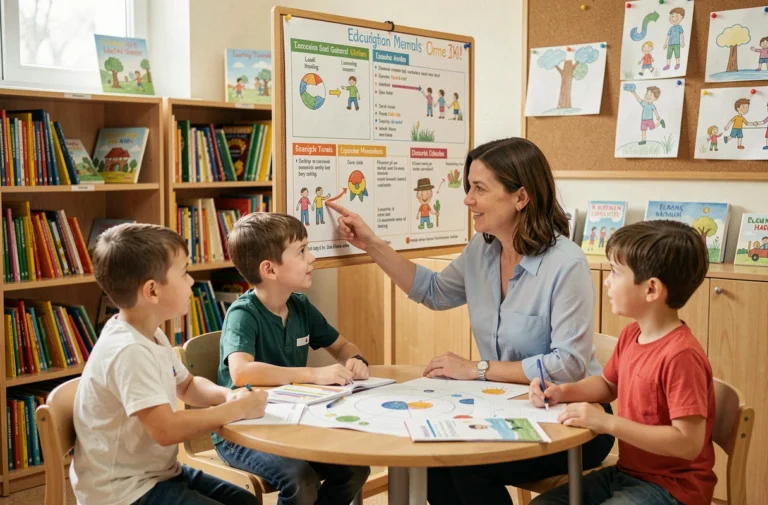
This same instruction provides for the development of group-based, local support, going beyond the idea of tips to apply on your own at home. Parent discussion groups, parent-child drop-in centres and workshops at community centres offer practical support that online articles cannot replace.

Birth leave and financial constraints: parental time comes at a cost
One piece of advice appears in almost every guide: “Make time for yourself.” The additional birth leave scheme allows each parent to take one or two months on top of existing leave, subject to certain conditions. On paper, this is progress.
However, the French National Health Insurance Fund states that benefits are capped and decrease over time. For a low-income household, lost wages can make this leave difficult to afford. Advising parents to slow down without mentioning this financial reality means ignoring part of the problem.
| Factor | Typical advice | Reality for many households |
|---|---|---|
| Time for yourself | Take a step back, delegate | No family support, cost of occasional childcare |
| Extended parental leave | Make the most of birth leave | Benefits decrease over time, resulting in a net loss of income |
| Calming routines | Establish peaceful evening rituals | Irregular hours, cramped housing, accumulated fatigue |
| Compassionate communication | Acknowledge your child’s emotions | Mental overload that limits emotional availability |
The table is not intended to discourage, but to offer an honest assessment. Useful advice takes a household’s real-life constraints into account, not just the parent-child relationship in isolation.
Screens at home: a question for adults too
Managing screen time is one of the topics parents search for most. The usual approach is limited to setting age-based time limits for children. The instruction of 6 November 2026 broadens the scope: it provides for supporting parents not only with children’s screen exposure, but also with adults’ screen use in the presence of children.
This shift changes the nature of the problem. A parent checking their phone during a meal or bath can affect the quality of the interaction without realising it. Reducing the issue to a ban on children’s screen use overlooks the reality of family dynamics.
Practical ideas for shared screen use
- Set screen-free times for everyone in the household, including adults, rather than rules that apply only to children
- Keep phone chargers out of shared living spaces (children’s bedrooms, the living room) to reduce the temptation to check your phone out of habit
- Use a timer that the whole family can see: when it goes off, everyone puts their device down, so no one household member is singled out
This collective approach has the advantage of avoiding power struggles. Children see that the rule applies to everyone, making it clearer and easier to accept.

Parenting support: moving from individual advice to collective support
Parenting advice articles work like prescriptions: a list of actions for one parent to follow alone in their day-to-day life. Local, group-based support can achieve results that information alone cannot.
A parent discussion group can help normalise difficulties. Learning that other households face the same tensions around bedtime, anger or mealtimes can ease feelings of guilt, which are themselves a contributing factor to burnout.
Parent-child drop-in centres, local associations and perinatal workshops provide practical support. Their development, set out in the November 2026 instruction, addresses a need that digital content cannot meet: the physical presence of a supportive third party when fatigue or isolation makes advice impossible to put into practice.
Parental peace of mind cannot be achieved simply by following a list of best practices. It depends on material conditions (income, housing, working hours), relationships (how tasks are shared, whether a support network is available) and institutional factors (leave schemes, accessible support services). A parent who identifies which of these areas is lacking has a more effective way forward than yet another tip for managing emotions.