
The development of an infant does not follow a universal timetable. Each child progresses at their own pace, influenced by their environment, interactions, and constitution. The usual milestones (holding their head up, smiling, grasping an object) serve as markers, not boxes to be checked in a strict order.
The first months concentrate an unparalleled density of learning experiences compared to the rest of life. The brain, senses, motor skills, and emotional bonds develop simultaneously, and the conditions in which a baby is welcomed weigh heavily on this trajectory.
Safe Sleep for Newborns: What the French Recommendations of 2024 Specify
The issue of sleeping arrangements is subject to regular updates. The page from the Assurance Maladie, updated on October 10, 2024, states a clear recommendation: the baby sleeps on their back, flat, in their own bed, preferably placed in the parents’ room for at least the first six months.
The point that deserves particular attention is the distinction between shared room and shared bed. Sharing the parental bed is not recommended, and the infant must be systematically returned to their own sleeping space before the parent falls back asleep. Many popular articles refer to “co-sleeping” without clarifying this nuance, which maintains confusion between nighttime proximity and sharing a sleeping surface.
Several online resources about babies on Future Maman detail the stages of an infant’s life, including issues related to sleep and nighttime safety.
Brain and Early Interactions: Why Exchanges Matter More Than Developmental Toys
The brain of a newborn develops at a speed that will not be replicated later. The formation of neural connections largely relies on interactions with the surrounding environment: gaze, voice, physical contact, response to crying.
The site 1000-premiers-jours.fr summarizes the mechanism: it is through discovering their environment and engaging in exchanges that the infant progresses. These interactions stimulate the construction of brain circuits much more than the accumulation of objects or toys designed for awakening.
Sensory Stimulation and Baby’s Rhythm
An excess of stimuli can have the opposite effect of what is intended. The infant needs quiet time between phases of active wakefulness. Observing their signals (averted gaze, restlessness, yawning) helps identify when they are overwhelmed.
Alternating moments of direct exchange (talking, singing, skin-to-skin) and phases of rest without stimulation creates a more favorable environment than one saturated with mobiles, music, and lights.
- Close visual contact (about twenty centimeters) corresponds to the distance that the newborn perceives best during their first weeks.
- The parent’s emotions directly influence the infant’s state: a calm tone of voice regulates their stress level.
- Simple toys (a fabric with varied textures, a lightweight rattle) are more than sufficient for the first months, without the need to multiply objects.
Infant Feeding: Breast Milk, Formula, and Hunger Cues
Feeding remains the most immediate need of the newborn. The World Health Organization recommends exclusive breastfeeding for the first six months, but infant formula is a nutritionally appropriate alternative when breastfeeding is not possible or desired.
In practice, feedings or bottles are done on demand. A newborn typically feeds every two to three hours, including at night. Signs of hunger (sucking movements, hands brought to the mouth, restlessness) appear before crying, which is a late signal.
What Changes After the First Weeks
The feeding rhythm evolves quite quickly. Quantities increase while the spacing between meals gradually lengthens. Each baby regulates their own food intake if hunger and satiety signals are respected, without forcing the end of a bottle or imposing a rigid schedule.

Medical Follow-up and Developmental Milestones in France
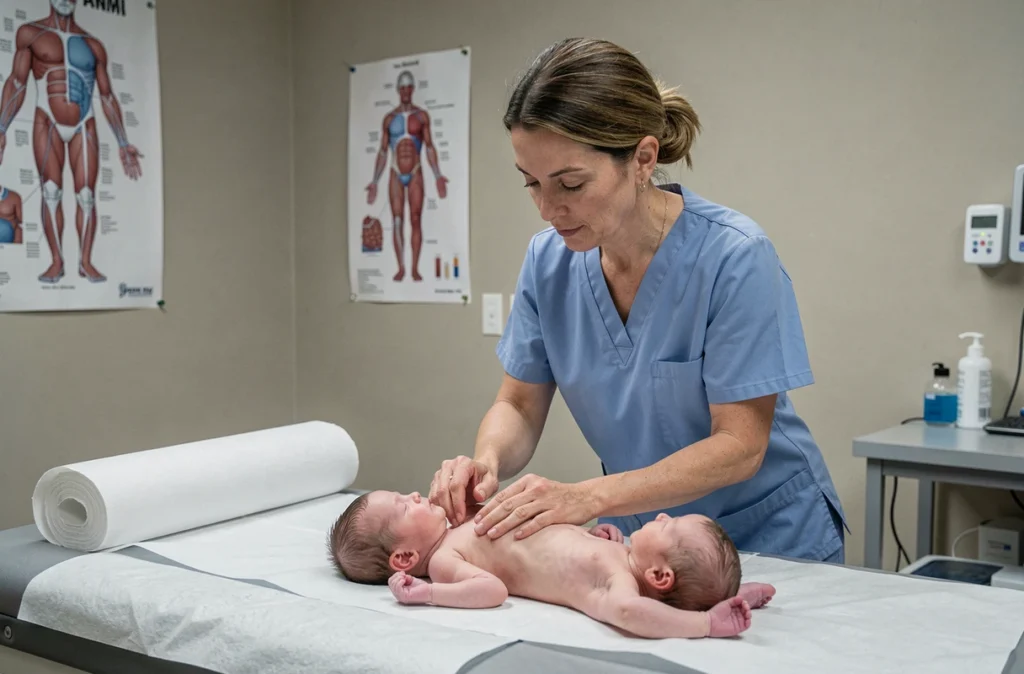
The first years of life are crucial and call for structured support. In France, the schedule of mandatory medical visits includes regular examinations during the first months.
These consultations are not only for vaccinations. They allow for checking growth, identifying potential delays in motor or sensory development, and supporting parents with practical questions (sleep, feeding, crying).
- The health booklet contains monthly developmental milestones, but these milestones describe broad ranges, not fixed alert thresholds.
- The PMI (Maternal and Child Protection) offers free follow-up accessible to all families, with professionals trained in early childhood.
- A recent report from the IGAS recommends strengthening the role of PMI in the early detection of perinatal vulnerability situations.
A discrepancy observed at a given moment does not mean a pathological delay. Developmental rhythms vary significantly from one child to another, and the available data do not always allow conclusions based on a single observation. Ongoing follow-up with a professional who knows the child remains the most reliable framework for assessing their progress.
The attention given to the first months is not limited to a list of technical gestures. It relies on a combination of presence, appropriate responses to the infant’s signals, and material conditions of safety, particularly for sleep. Parents who have concerns about their child’s development find in regular medical follow-up a concrete support, more reliable than standardized checklists consulted in isolation.