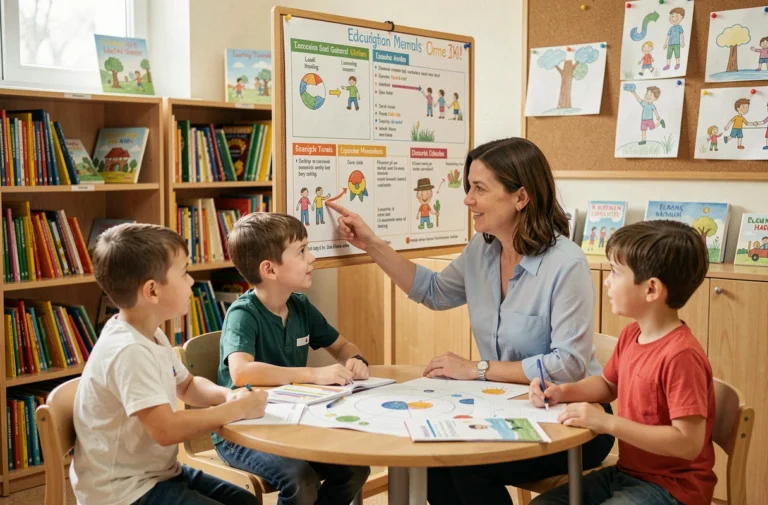
A child who refuses to dress alone at five years old, another who loses focus on their homework after the second line: we all know these situations where daily development seems to be hindered by a very concrete detail. Supporting a child’s development is not just about applying general principles of kindness. It involves precise adjustments tailored to what is causing difficulties throughout the day.
Parental technoférence: when the adult’s screen hinders the child’s development
There is a lot of talk about children’s screen time. There is less discussion about parents’ screen time during interaction moments. Technoférence is the interruption of parent-child exchanges by the adult’s phone. It affects language, attention, and emotional skills in young children.
In practical terms, this occurs at the table, in the park, during bath time. A parent checking their messages while their child shares their day sends a signal of disengagement. The child learns to stop seeking attention or, conversely, to increase attention-seeking behaviors.
Professionals recommend observing not the total screen time, but what the screen replaces in shared moments. Instead of setting a universal threshold in minutes, one can choose a realistic change: putting the phone in another room during meals, turning off notifications between school pick-up and bedtime.
To delve deeper into these issues, Naturally Mom’s child resources offer concrete ideas for daily support.

Children’s autonomy by age: suitable tasks rather than vague goals
Autonomy is a word found everywhere in parenting guides. The problem is that it often remains abstract. Telling a three-year-old to “be autonomous” produces nothing. Showing them how to put on their shoes, then letting them try alone with enough time, leads to learning.
Adapting the task to motor skills and maturity
A two- to three-year-old can put their toys away in a bin at their height, place a napkin on the table, or water a plant with a small watering can. At five to six years old, they can be entrusted with preparing their backpack, sorting clean clothes, or participating in a simple recipe.
The criterion for success is not perfection, but repetition without constant adult intervention. If we constantly redo tasks behind the child, the message received is that their contribution is worthless.
- Choose one task per week and keep it stable for at least ten days before adding another, to avoid scattering attention
- Place necessary materials within reach: low hooks for coats, a stable stool in the kitchen, accessible shelves for books
- Accept an imperfect result without correcting in front of the child, even if adjustments are made discreetly later
Feedback varies on the time needed for a habit to establish in a young child, but consistency matters more than speed.
Activities that build confidence: prioritizing the process over the result
Extracurricular activities are often associated with development. Sports, music, drawing: everything seems beneficial. In practice, a poorly chosen or forced activity can produce the opposite of the desired effect.
Observe before enrolling
Before choosing an activity, it is beneficial to observe what the child does spontaneously when they are free. A child who spends time stacking, building, or dismantling will likely find more satisfaction in a DIY workshop than in a dance class. A child who invents stories with their figurines may need theater, not football.
The classic trap is projecting our own desires or filling the schedule out of fear of emptiness. However, unstructured time is often an underestimated lever for development. Boredom pushes the child to invent, negotiate with themselves, and explore.

Value effort over talent
Saying “you are gifted” locks the child into an identity. Saying “you tried several times before succeeding, that’s what worked” reinforces perseverance. This distinction, well documented in motivation research, changes how the child approaches academic challenges and new learning.
Screens and family life: a responsibility that goes beyond the home
Public Health France suggests not placing the management of screens solely on parents. Regulation of platforms, media education in schools, and collective interventions should complement the rules set at home.
This approach shifts the perspective. It moves from a family blame logic to a shared responsibility between parents, schools, and public authorities. Practically, this also means that parents can rely on local initiatives: sports and cultural activities offered by municipalities, workshops in libraries, supervised nature outings.
- Identify free or low-cost activities in the community (libraries, toy libraries, sports associations) to provide concrete alternatives to screens
- Discuss each family member’s digital usage, including adults, to avoid double standards
- Propose one change at a time rather than a complete overhaul of habits, which reduces resistance
Supporting a child’s development is not done with principles displayed on the fridge. It involves adjusting what actually happens throughout the day, meal by meal, trip by trip. Major educational theories have their place, but it is in the logistical details and micro-decisions that trust, autonomy, and curiosity are built.