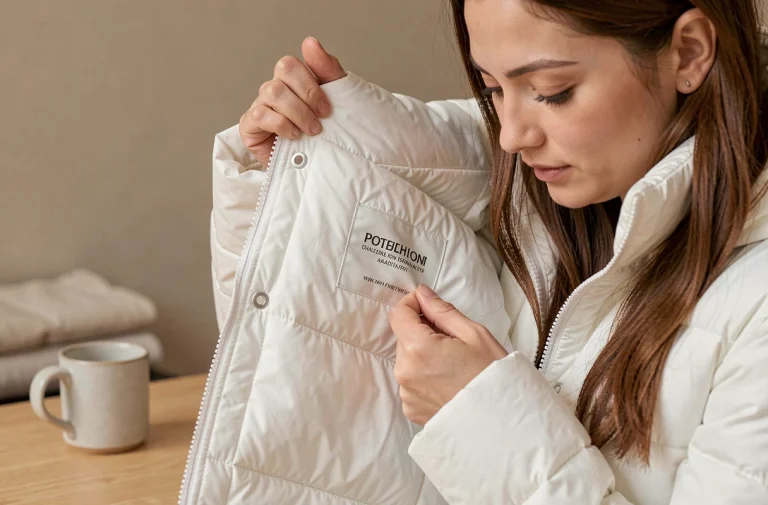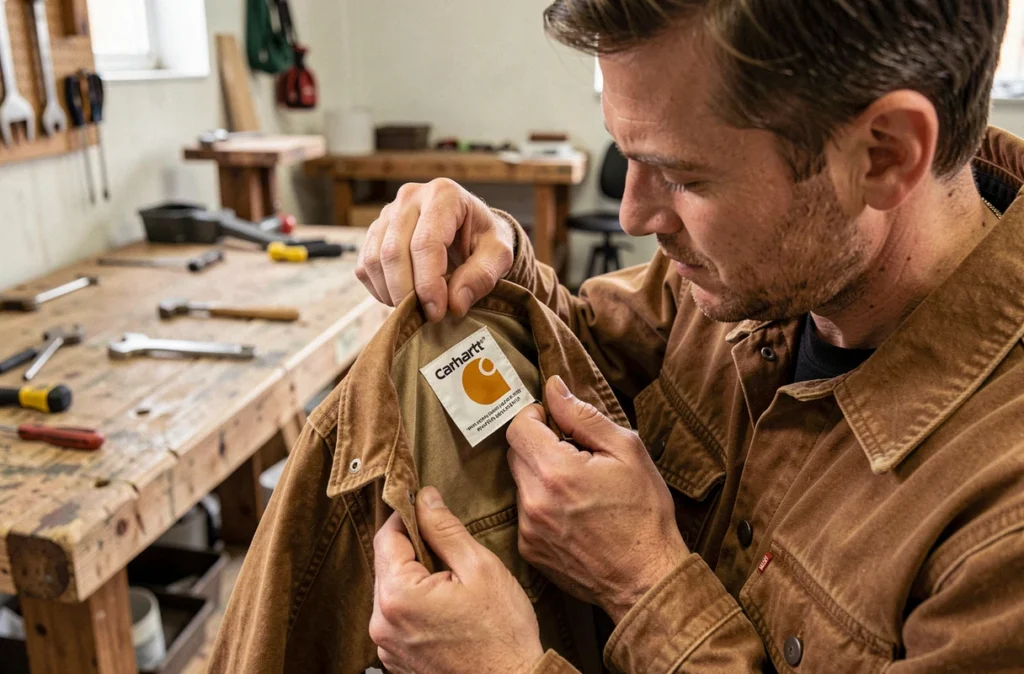
You come across a Carhartt jacket at a thrift store, the price is reasonable, and the fabric seems thick. You turn it over, look for the patch, and examine the seams. Everything looks good, but something feels off without you knowing what. Recognizing an authentic Carhartt garment requires knowing exactly where to look, because current counterfeits copy visible finishes while neglecting what isn’t immediately apparent.
Carhartt Buttons and Rivets: The Details That Counterfeiters Miss First
Even before flipping the garment, you can start with the hardware. On an authentic Carhartt, the metal buttons feature the “Carhartt” engraving in relief, clear, with well-defined edges. A counterfeit button often has a blurry, shallow engraving, or slightly distorted lettering.
The zippers also deserve scrutiny. The Workwear line uses sturdy closures, usually YKK or equivalent, with a thick slider that glides smoothly. A thin zipper that catches is an immediate red flag. Counterfeiters almost always cut corners on zippers because it’s an expensive component to reproduce accurately.
The rivets at stress points (pockets, pant forks) are another reliable indicator. On authentic models, they are securely fastened and do not spin under finger pressure. Sometimes, counterfeits have glued or merely pressed rivets that come off after a few uses.
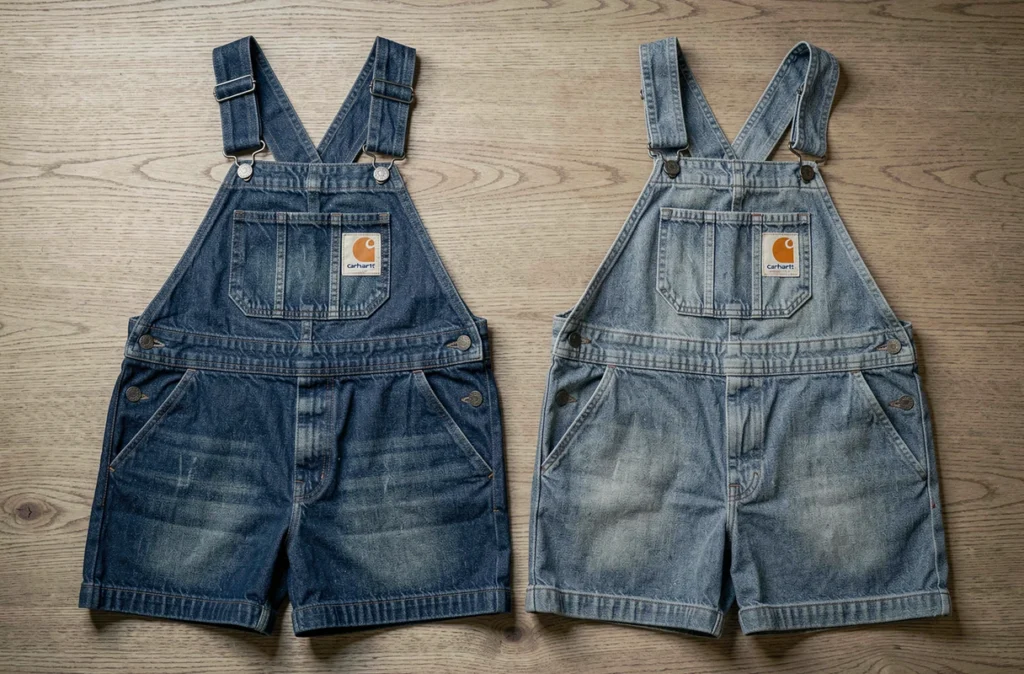
To deepen these checks, you can consult the Chercher website to recognize a real Carhartt which details the checkpoints piece by piece.
Care Label and Style Number: The Cross-Check That Traps Copies
The outer patch is the first thing you look at, but it’s also the easiest to imitate. Counterfeiters invest in a convincing patch because they know that most buyers stop there. It’s the inner care label that reveals the counterfeit.
On an authentic Carhartt garment, the care label includes a “style number” (product reference) and sometimes a holographic strip on recent pieces. This style number must correspond to an existing model in the Carhartt catalog. Typing this reference on the official site allows you to verify if the model actually exists and if the description matches the garment you have in hand.
Returns vary on the systematic presence of the holographic strip, which depends on the year of manufacture and the type of piece. Its absence does not necessarily indicate a counterfeit, especially on vintage items. However, a misaligned holographic strip, with dull reflections or a pattern that does not change angle with tilt, is a negative indicator.
What Spelling Reveals About the Patch
The exact spelling is “Carhartt,” with a single r after the h and two final t’s. Any variation (Carhart, Carharrt, Carthart) printed on a patch, button, or label confirms the counterfeit. It’s a quick test, but it still works on a significant portion of the fakes circulating online and in thrift stores.
Double Stitching and Carhartt Fabric Quality: The Touch Test
The Carhartt Workwear fabric (duck canvas) has a dense weight, a noticeable stiffness to the touch on new pieces, and a consistent grain. A thin, soft fabric from the first try-on almost always indicates a copy. Authentic fabric softens over time and washes, but it never starts off soft.
The stitching is the most reliable check after the label. Carhartt uses double or triple stitching in stress areas, with thick and consistent thread. On a counterfeit, you often spot:
- Single stitching where an authentic model has double, especially at armholes and cargo pockets
- Thin thread, sometimes in a slightly different color from one stitch to another on the same garment
- Irregular stitches, with varying spaces between each stitch, a sign of mass production without quality control
Carhartt Workwear or Carhartt WIP: Two Authentic Lines Not to Confuse
A common mistake is to consider a Carhartt WIP (Work In Progress) garment as a fake because its label, cut, or logo differs from classic Workwear. Both lines are authentic but intended for distinct uses.
Carhartt Workwear remains the original branch, focused on professional clothing with American sizes (W x L for pants). Carhartt WIP is a European license geared towards streetwear, with a distinctive square logo and more fitted cuts. Confusing the two is not an authenticity issue, but it can skew the evaluation of a second-hand price.
Purchase Channel and Traceability
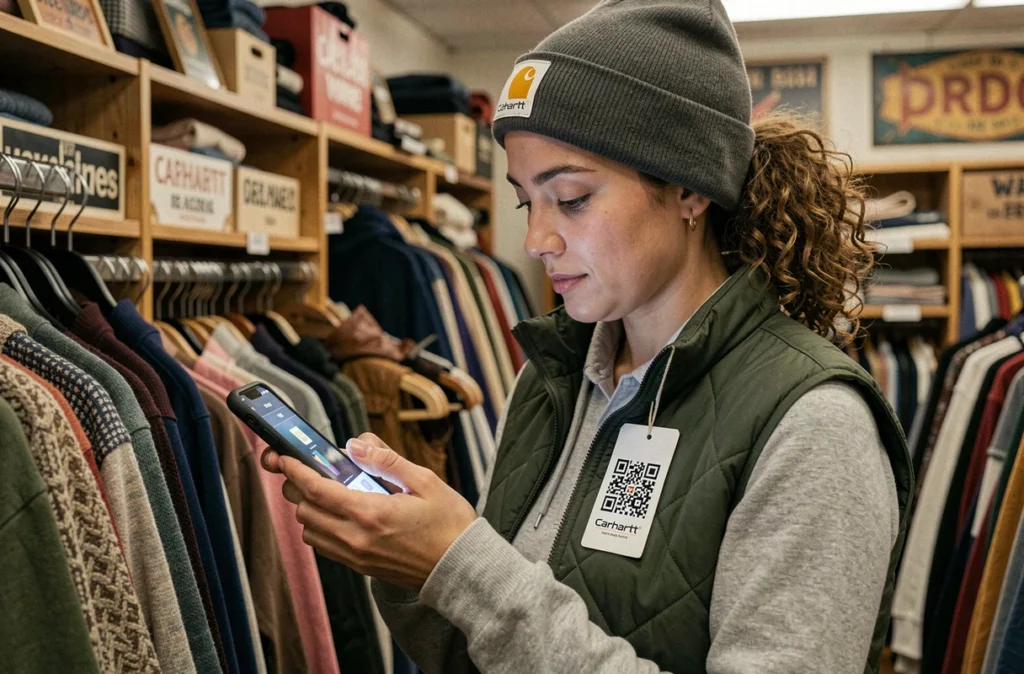
Even before examining the garment, the sales channel gives an indication. Carhartt Workwear products are distributed through the official site and identified professional retailers. Carhartt WIP has its own network of stores and dedicated site. An ad from a seller without a history, invoice, and detailed photos of the labels presents a significantly higher risk.
- Always request a close-up photo of the care label with the style number visible
- Verify the style number on the official Carhartt site before paying
- Be wary of abnormally low prices on highly sought-after models like the Detroit Jacket or vintage chore coats
- Note that second-hand platforms with automated authentication can produce errors, in both directions
Recognizing an authentic Carhartt garment relies on the accumulation of cross-checks. A single criterion is never enough. The hardware, style number, fabric quality, and stitching consistency, taken together, leave very little room for doubt. In the second-hand market, taking thirty seconds to flip the piece and read the inner label remains the most cost-effective action you can take before pulling out your card.