When you buy a Pyrenex down jacket on a marketplace or in a thrift store, you receive it, and after three days the down starts escaping through the seams. Doubts arise. Recognizing a counterfeit before pulling out your credit card requires checking specific details, not relying on a general impression.
Pyrenex, a French brand specializing in down for over a century, remains a regular target for counterfeiters, especially for the most sought-after models like the Authentic or the Spoutnic.
Product reference and European regulation: the first anti-counterfeit filter for Pyrenex
Since December 13, 2024, Regulation (EU) 2023/988 on the general safety of products requires online sellers in the EU to display a clear product identifier on each product page: model number, batch number, or serial number, along with the manufacturer’s contact details or a representative established in the EU.
Specifically, when viewing a Pyrenex down jacket on a website, the product page must mention a reference consistent with the physical label of the garment (model code, EAN code). If the product page does not have any identifier, or if the displayed code does not match any listed Pyrenex model, it is a regulatory warning signal, not just a simple oversight.
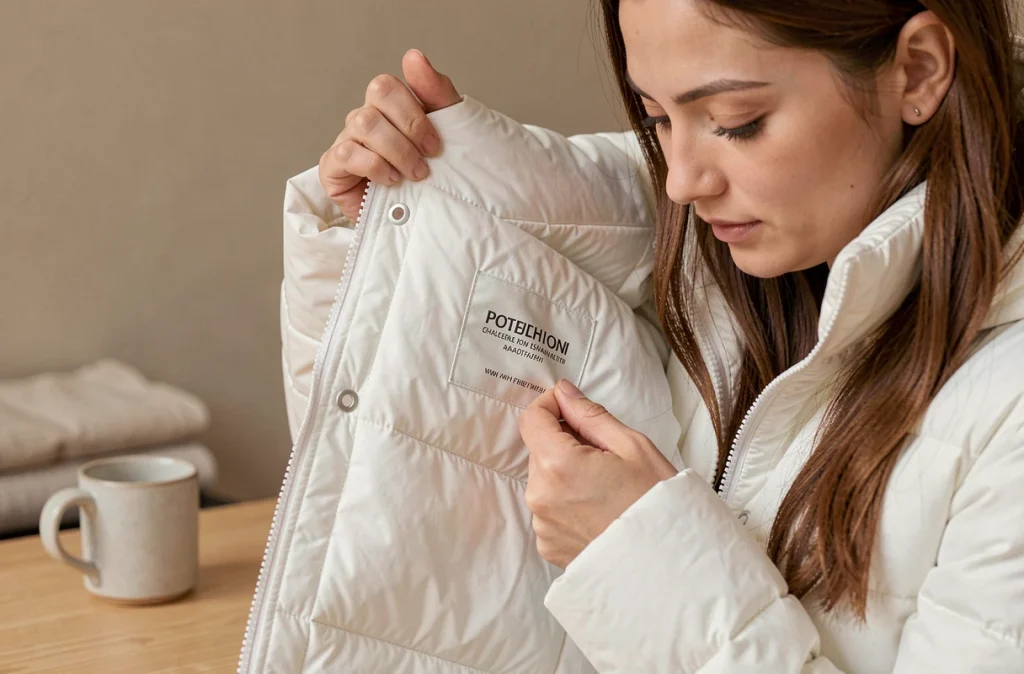
This filter also works upon receipt. You can distinguish a genuine Pyrenex by comparing the model number sewn on the inner label with the one listed on the sales page. A discrepancy between the two is enough to justify a return.
Physical traceability on a Pyrenex down jacket: what the labels must contain
The same European regulation now requires that traceability information be physically present on the product or its packaging, not just online. For Pyrenex, this translates into several elements sewn into the lining.
- The full name of the manufacturer and their contact details, directly on an inner label. A counterfeit often displays a generic name or an incomplete address.
- A readable model or batch number, without typographical errors. Counterfeits sometimes reproduce an existing code but with an extra letter or a reversed number.
- The exact composition of the filling (percentage of down and feathers, origin), mandatory in France for any textile item. A vague label like “100% polyester” on a model supposed to be duck down is a dealbreaker.
You can also check for the presence of the embroidered Pyrenex logo (not simply printed on a glued patch). On recent models, the embroidery is clear, even, without loose threads. Returns vary on this point depending on the batches, but coarse embroidery remains a reliable indicator.
Seams and down filling: details that a counterfeit misses
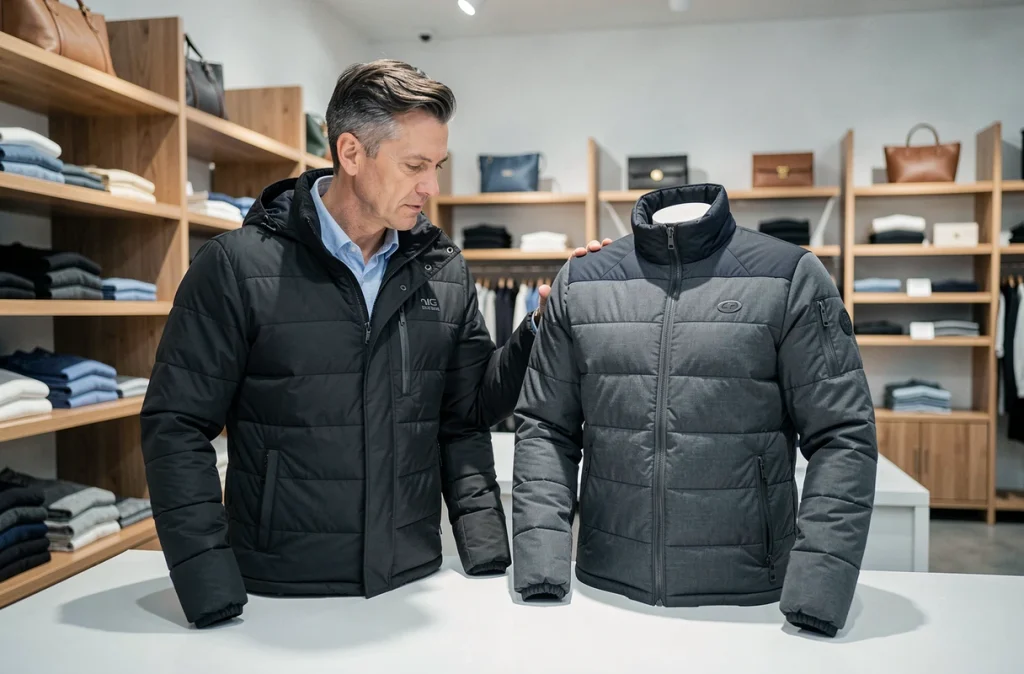
Counterfeiters replicate the external appearance of a down jacket quite well. Where they fail is in the internal construction. Pyrenex uses partitioned down compartments that prevent the filling from migrating to the bottom of the garment. On a counterfeit, it is often observed that the down accumulates at the bottom of the jacket after a few days of wear.
To test before purchase (in-store or upon receipt), squeeze a compartment between your fingers. Quality down re-inflates in a few seconds. Synthetic filling or poor-quality down remains flattened longer.
The outer seams also deserve inspection. On a genuine Pyrenex, the topstitching is even and does not allow feathers to escape. Micro-feathers escaping through the seams indicate a fabric of poor density, characteristic of copies.
The zipper, a detail often overlooked
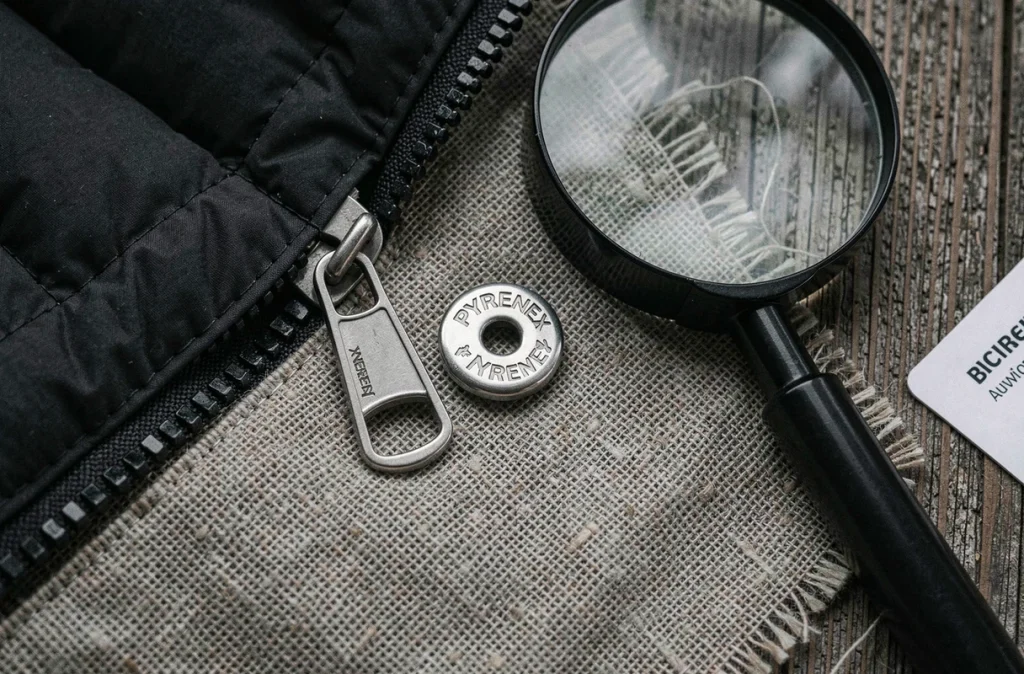
Pyrenex uses branded zippers (most often YKK or equivalent quality) on its down jackets. On a counterfeit, the zipper is generally unmarked, thinner, and gets stuck after a few uses. Check the engraving on the slider: a smooth slider without inscription should raise a red flag.
Online purchase and suspicious prices: where Pyrenex counterfeits concentrate
The majority of counterfeits circulate on general marketplaces and ephemeral sites that offer Pyrenex down jackets at prices well below the usual rate. An Authentic model sold for less than half the retail price, outside of official sale periods or identified outlet stores, should trigger suspicion.
- Prefer the official Pyrenex website, authorized resellers, or identified physical outlets (like those found in recognized brand villages).
- Check that the seller displays a product identifier and a contact address in the EU, in accordance with Regulation 2023/988.
- Consult reviews about the seller, not just the product. A recent seller with hundreds of down jackets in stock at cut prices is a classic counterfeit scheme.
The absence of a clear return policy is another marker. Counterfeit sites deliberately complicate return procedures to discourage claims.
The place of manufacture mentioned on the label can also guide you. Pyrenex has historically produced in France, but some models are made in other countries. The “Made in” label must match the information available on the official website for the relevant model. An absent or inconsistent “Made in” label is an additional clue.
No single criterion is sufficient. It is the combination of the product reference, the quality of the filling, the sewing finishes, and the sales channel that allows for a decision. Taking thirty seconds to cross-check these elements before confirming a purchase can save weeks of return procedures, or worse, ending up with a coat that offers no protection.