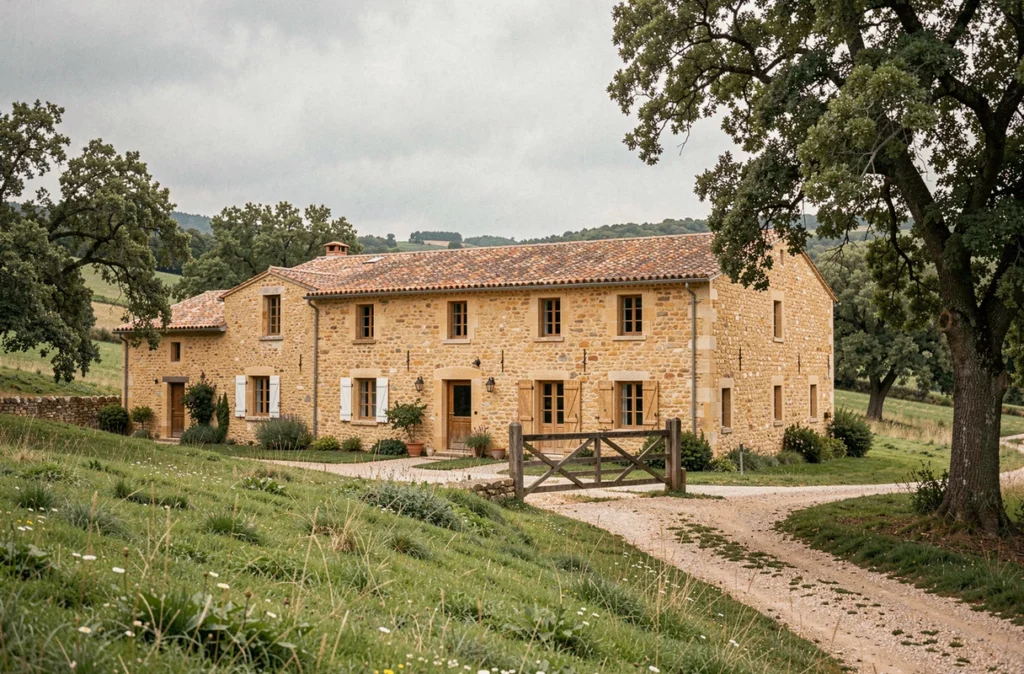
The Lot department displays real estate prices significantly lower than those of the metropolitan areas of the Toulouse and Montpellier arc, while the regional average in Occitanie continues to rise. This near-stagnation, sometimes accompanied by a slight correction since 2024, places the Lot in a unique position for investors.
The entry ticket remains accessible and there are opportunities for growth. Measuring this gap with the rest of the region helps to understand what makes this market attractive, and what warrants caution.
Price Gap Between the Lot and the Rest of Occitanie: A Catch-Up Market
The real estate dynamics of the Lot are characterized by a structural lag compared to the departments driven by Toulouse or Montpellier. Where these metropolitan areas have experienced sustained increases, prices in the Lot are rising much more slowly, or even stagnating.
| Indicator | Lot (46) | Toulouse / Montpellier Arc |
|---|---|---|
| Price Trend 2022-2025 | Near stagnation, slight correction since 2024 | Sustained increase, regional average trending upwards |
| Entry Ticket (houses) | Among the lowest in the region | Significantly higher |
| Rental Pressure | Moderate, except in tourist areas | Strong, driven by demographics and employment |
| Share of Second Homes | Increasing in tourist municipalities | Stable or slightly decreasing |
This table outlines a two-speed market. For an investor, the Lot offers access to real estate in Occitanie without experiencing the overheating of large urban areas. The listings available on https://www.lot-immobilier.fr/ illustrate this diversity of properties at price levels that are no longer found around Toulouse.
Rental Investment in the Lot: Two Distinct Markets to Navigate
The Lot does not form a homogeneous block. Rental pressure is concentrated in well-identified pockets, and investment strategies vary depending on whether one targets seasonal rentals or long-term rentals.
Tourist Areas and Seasonal Rentals
The valley municipalities, classified villages, and heritage sectors (Dordogne Valley, Lot Valley, Rocamadour, Saint-Cirq-Lapopie) have seen a significant increase in furnished tourist accommodations since 2023. The use of short-term rental platforms is growing there.
The demand mainly focuses on small spaces and charming houses. This segment offers attractive seasonal returns, but with a constraint: property management is more burdensome and the regulations for furnished tourist accommodations are tightening at the national level.
Rest of the Territory and Long-Term Rentals
Outside of tourist pockets, the demand is primarily residential. Cities like Cahors or Figeac concentrate the needs for year-round housing. The pressure remains moderate, which limits the risks of excessive vacancy without guaranteeing exceptional returns.
- In tourist areas, the gross yield is driven by seasonality, but management and maintenance costs reduce the net margin
- In town centers, profitability relies on the regularity of annual rents and a low purchase price
- Properties needing renovation represent a significant part of the supply, with potential for capital gain if the work is properly budgeted
Energy Renovation and Aids: A Concrete Lever for Profitability
The real estate stock in the Lot includes a notable proportion of old housing, often classified in low energy categories. This characteristic, which could deter some buyers, serves as a lever for informed investors.
MaPrimeRénov’ remains the main aid program for energy renovation, although the conditions are regularly evolving. Since September 2026, certain works such as wood stoves, isolated windows alone, or individual insulation measures are no longer eligible under the program in its classic form. The aid is refocusing on large-scale renovations, with a jump of at least two energy classes on the DPE.
For an investor in the Lot, this means that comprehensive renovation projects are now the only ones to fully benefit from the aids. Buying a poorly rated property, planning a complete renovation, and aiming for a gain of two DPE classes allows for the accumulation of subsidies and appreciation of the property upon resale or rental.
The eco-PTZ (zero-interest loan for renovation) remains accessible to finance certain complementary works, including insulation and ventilation, even those that have fallen outside the MaPrimeRénov’ perimeter since September 2026.
Low Prices and Second Homes: What the Numbers Really Mean
The increase in the share of second homes in the tourist municipalities of the Lot is not trivial. It modifies the structure of the local market in two ways.
First, it supports prices in the most sought-after micro-markets (character villages, riverbanks). Buyers of second homes accept prices per square meter higher than the departmental average, which creates a valuation floor in these areas.
Secondly, it reduces the supply of housing available year-round in these same sectors. For permanent tenants, competition with tourist accommodations can create occasional tensions, especially in high season.
Conversely, rural areas far from tourist circuits remain very accessible. The risk is different there: liquidity upon resale may be low if the local job market does not strengthen.
Real Estate Market in the Lot After 2024: A Buying Window That Is Clarifying
Jean-Luc Perrier, president of FNAIM for the Lot, reminds us that activity dropped by 20 to 30% in revenue and volume in 2023 and 2024, following the post-Covid influx of 2020-2022. This correction has led to agency closures, but it has also brought the market back to a level considered normal for older properties.
New properties, on the other hand, remain at a standstill. This situation creates an imbalance: demand is shifting to older properties, where stocks are slowly being replenished. For a buyer, this is a favorable configuration, with sellers more willing to negotiate than during periods of overheating.
- Properties remain on the market longer, allowing time for analysis and negotiation
- Prices have not undergone a sharp correction, which limits the risk of capital loss
- The gradual decline in credit rates observed nationally improves borrowing capacity
The Lot remains a niche market in Occitanie, where profitability is built on a controlled purchase price, a well-calibrated renovation strategy, and a clear choice between tourist seasonality and long-term rental. The current window, between volume correction and price stability, gives methodical investors an advantage that periods of euphoria do not offer.