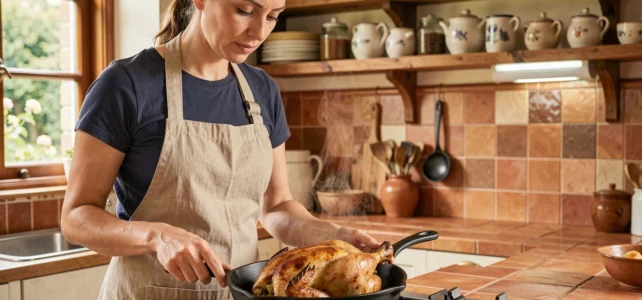
Cooking represents the moment when a dish tips: one degree too much, a poorly chosen pan, and the result changes completely. The French are spending less and less time on it in the evening, with a reported average of 25 minutes per evening in the kitchen in 2025, compared to 30 minutes in 2007. This compression of time pushes for a better understanding of what is really happening in a pot or an oven, rather than multiplying recipes.
Conductivity and thermal inertia: what your equipment changes in cooking
The choice of a pan or pot determines the distribution of heat even before you place food on it. A stainless steel pan heats up quickly but concentrates heat in the center, where the flame or heating element acts directly. Cast iron, on the other hand, heats up slowly and then distributes heat evenly across the entire surface.
This behavior has direct consequences. To sear a piece of meat with an even crust, cast iron or carbon steel provides inertia that maintains the temperature even when the cold food comes into contact with the surface. A thin aluminum pan, however, loses several dozen degrees at that precise moment, resulting in a steaming effect rather than a Maillard reaction.
The current market shows a clear polarization: growth is very strong in the low-cost pan segment, while the mid-range is declining and the high-end stainless steel or premium cast iron is holding up better. Checking cooking times on 3 Coups 2 Fourchette allows for adjusting the duration according to the type of equipment used, which avoids approximations.
Oven cooking: mastering convection heat and preheating
The oven remains the most underutilized appliance in home cooking. Many amateur cooks put a dish in the oven without complete preheating, which skews all the time references indicated in a recipe. An oven that has not reached its target temperature at the time of baking extends cooking time unpredictably and alters the final texture.
Convection heat and natural convection do not produce the same result. Forced convection (convection heat) dries out the surface of foods more, which is suitable for gratins, pastries that need to crust, and roasted vegetables. In contrast, for a moist cake or fish in parchment, natural convection preserves internal moisture.
Adjusting temperature according to heat mode
Reducing by 10 to 20 degrees in convection heat compared to a recipe written for a traditional oven is a reliable rule. Air circulation accelerates thermal exchanges, and without this adjustment, the surface burns before the center is cooked.
Another common pitfall concerns the position of the rack. Placing a dish too high exposes the surface to intense direct radiation. For even cooking, the middle rack remains the default choice, except for gratins (top third) or homemade pizzas (bottom third, on a stone or preheated tray).
Air fryer in home cooking: promises and real limits
The air fryer has established itself as the flagship appliance of recent years. According to an IFOP study for Pyrex, users report time savings, a perception of healthier cooking, and energy savings. The appliance far exceeds the “fries” usage: roasted vegetables, gratins, cakes, and even saucy dishes are now being made in it.
Field feedback diverges on certain points. The texture obtained in an air fryer is not identical to that of traditional frying or an oven. The appliance works by very rapid convection in a small space, which crisps the surface but can dry out lean foods (chicken breast, white fish) if the time is not adjusted precisely.
- Starchy foods (fries, potatoes) yield the best results, provided the basket is not overloaded to allow air circulation.
- Thinly sliced vegetables (zucchini, peppers, broccoli) roast in a few minutes but require a light coating of oil to prevent excessive drying.
- Compact pastries (muffins, small cakes) cook evenly, while liquid preparations or thin pie crusts pose more difficulties.
Food safety and core temperatures: the often overlooked point
Successfully cooking does not just mean achieving a nice color or pleasant texture. The core temperature determines whether a food is safe to consume. Common pathogenic bacteria in restaurants and home kitchens (salmonella, listeria, E. coli) are destroyed beyond certain thermal thresholds that color alone does not guarantee.
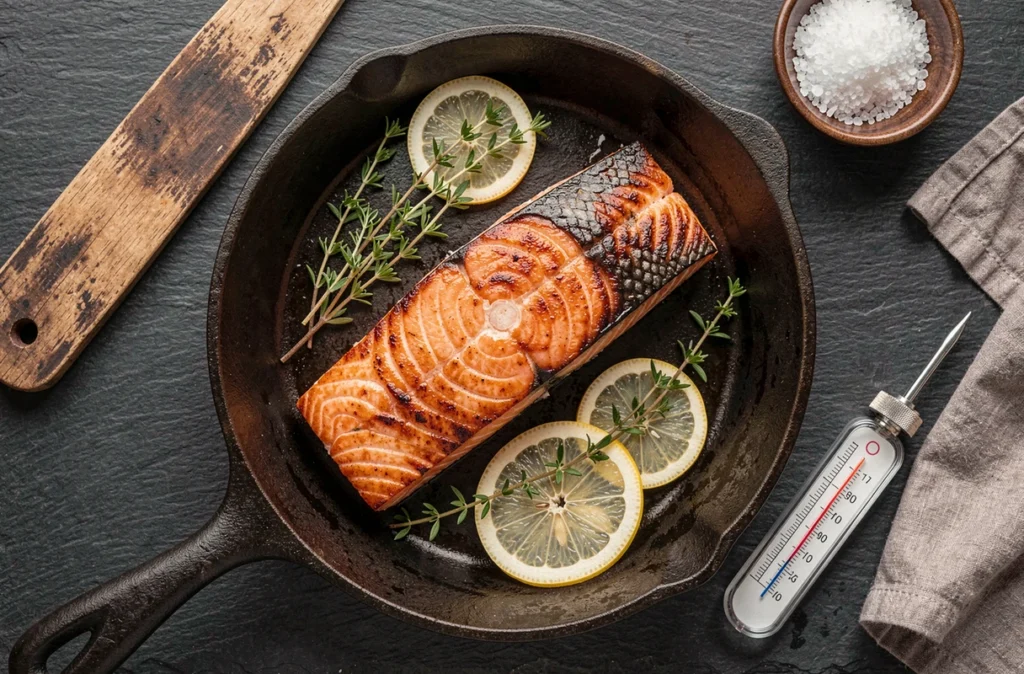
A probe kitchen thermometer costs a few euros and transforms the reliability of your cooking. For poultry, aiming for a sufficient internal temperature to eliminate risks remains the only reliable method. The pink or white color of the meat is not a sufficient indicator.
Batch cooking and rapid cooling
Batch cooking, which involves preparing several meals in one session, is gaining popularity. A virologist recently warned about the risks associated with slow cooling of preparations. A dish left at room temperature for more than two hours enters the bacterial proliferation zone.
For those who prepare in advance, dividing dishes into small portions speeds up cooling. Placing containers in the refrigerator as soon as steam stops escaping limits the time spent in the critical zone.
- Never stack hot containers in the refrigerator: this raises the internal temperature of the appliance and endangers other stored foods.
- Prefer shallow containers so that the center of the preparation cools as quickly as the edges.
- Label each container with the preparation date to ensure consumption within three days maximum in the refrigerator.
The success of cooking in home kitchens relies less on the accumulation of recipes than on understanding a few physical mechanisms: heat transfer, choice of suitable equipment, control of core temperature. A thermometer, a pan whose thermal behavior is known, and a properly preheated oven cover most everyday situations.