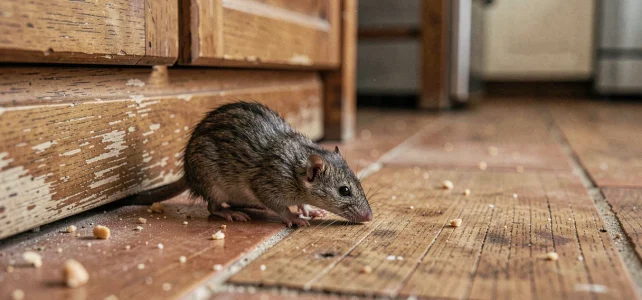
The shrew is an insectivorous mammal of the order Eulipotyphla, related to the mole and the hedgehog. Its presence in a house is neither an infestation nor pure chance: it reflects specific environmental conditions around the habitat. Understanding what this animal is seeking and what its presence reveals about your home first requires observing the signs it leaves behind.
Shrew and leptospirosis: an underestimated environmental signal
Articles dedicated to shrews rightly repeat that they are harmless. Their bite is extremely rare, and they do not gnaw on cables or provisions. Where the analysis often stops is on what their recurring presence indicates about the environment that attracts them.
A shrew frequents damp areas, poorly ventilated crawl spaces, muddy surroundings, and basements where water stagnates. These same biotopes are shared by rats, the main vectors of leptospirosis. According to Santé publique France, the incidence of this disease has doubled in France between 2014 and 2024.
The shrew itself does not transmit leptospirosis. However, its repeated presence signals a habitat favorable to rodent carriers of leptospires. A damp basement that regularly hosts shrews deserves a broader inspection: check for leaks, look for signs of rats, and control stagnant water points. To better understand the significance of the shrew in the house, it is necessary to analyze all of these environmental factors.
Shrew or mouse: reliable distinguishing criteria
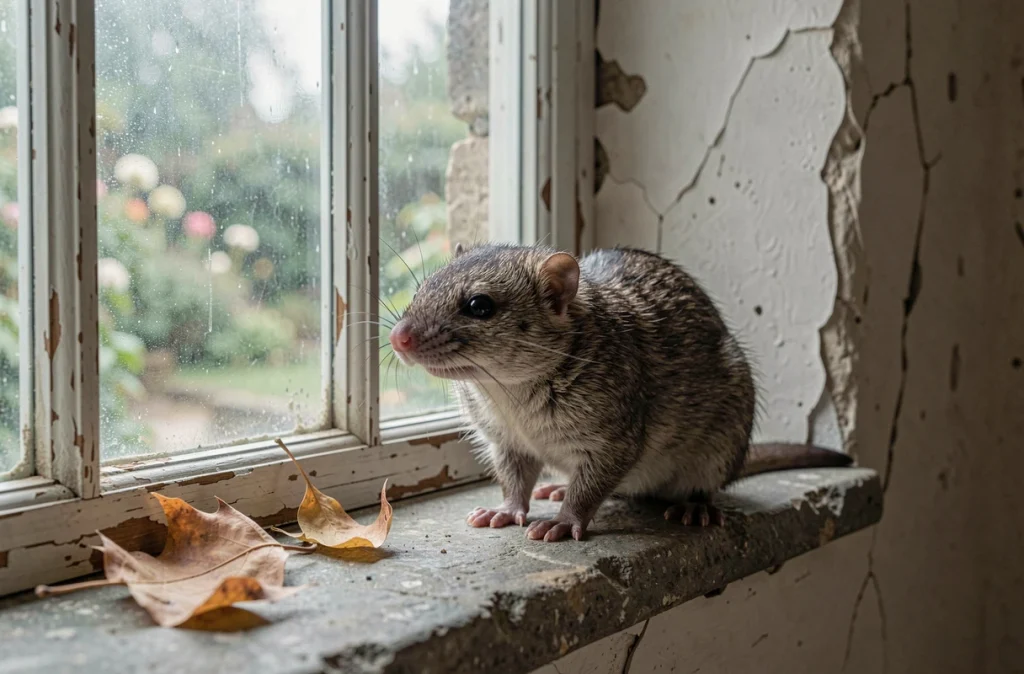
Confusing a shrew with a mouse leads to inappropriate reactions (rodenticides, bait traps). Three morphological criteria allow for a clear distinction.
- The snout: the shrew has a long and mobile snout, significantly more pointed than that of a mouse, which remains rounded and short.
- The eyes and ears: in the shrew, the eyes are tiny, almost invisible under the fur, and the ears are very small. The mouse has bulging eyes and large round ears.
- The smell: shrews secrete a powerful musk from lateral glands. This odor, absent in domestic mice, explains why cats catch them but generally refuse to eat them.
Feeding behavior also differs radically. The shrew is strictly insectivorous: worms, larvae, slugs, spiders. It never attacks stored grains or packaging. The absence of gnawing marks on your provisions excludes a rodent.
Protected species and legal framework in France
The shrew does not belong to the category of species likely to cause damage (ESOD). In France, certain species of shrews are protected under the decree of April 23, 2007, which sets the list of protected terrestrial mammals. Killing or capturing these animals without a prefectural exemption constitutes an offense.
This legal point has direct practical consequences. Rodenticides (rat poison) are not only useless against a shrew (it does not consume grain baits), but their use in a context where the animal is protected exposes one to prosecution. The only legal device remains the live capture trap, of the type that allows for a release at a distance.
Releasing a captured shrew
The shrew has an extremely fast metabolism. Deprived of food for just a few hours, it can die of exhaustion. A live capture trap must therefore be checked very frequently, ideally every two to three hours. The release should be done about a hundred meters from the building, in a covered environment (hedge, woodpile, wooded edge) where the animal will find prey.
Sealing access points: the only sustainable prevention against shrews
No chemical or ultrasonic repellent has proven effective against shrews. The most reliable approach is to eliminate entry points and reduce the attractiveness of the home.
Shrews can squeeze through openings the size of a pencil. Their flexible skeleton allows them to pass through gaps that one would consider too small for a mammal. The entry points to inspect as a priority are the facade plumbing passages, basement door thresholds, ventilation grilles without fine mesh, and cracks at the base of walls.
- Install fine mesh screening on ventilation openings (diameter less than one centimeter).
- Seal plumbing passages with steel wool or mortite, materials that the animal cannot cross.
- Dry out damp areas around the building: poorly oriented gutters, persistent puddles, clay soil against the foundations.
Reducing ambient humidity in basements and cellars also decreases the population of insects and worms that the shrew feeds on. Fewer available prey means fewer reasons for the animal to approach.
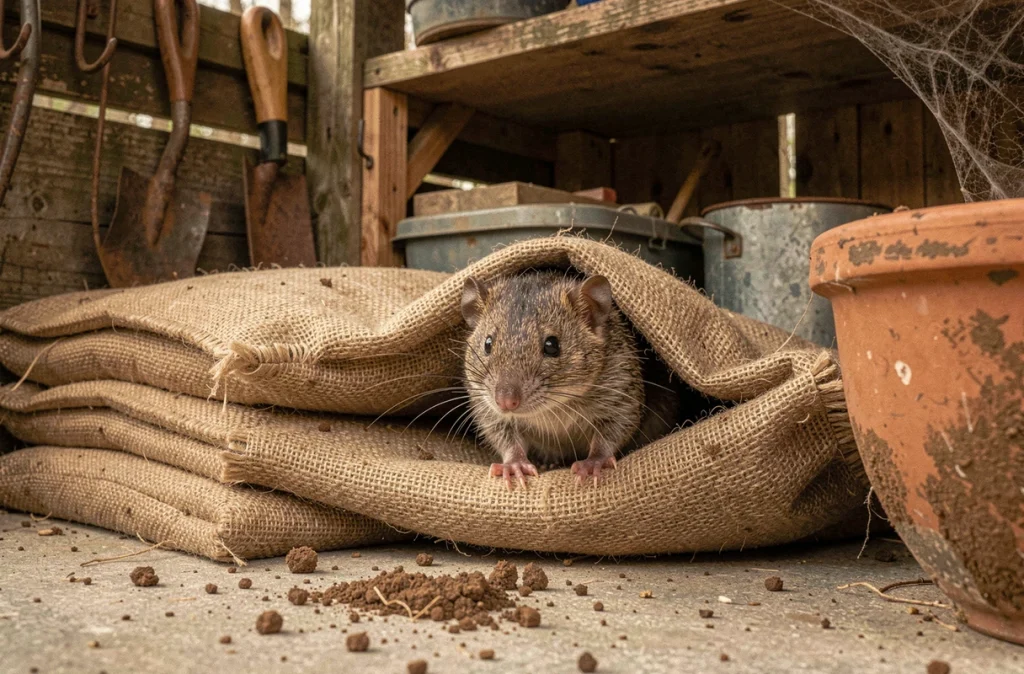
The shrew in a house is neither a pest in the regulatory sense nor a direct health danger. It rather functions as a bio-indicator of humidity and the presence of invertebrates. Addressing the signal (sealing, ventilating, sanitizing) makes intervention on the animal itself unnecessary in most cases.