

Photography holds a unique place in the art world. Long considered a secondary medium compared to painting or sculpture, it has gradually established itself as a legitimate form of expression, recognized by major museum institutions, auction houses, and the most discerning collectors. From prints by Man Ray to the monumental works of Andreas Gursky, and including limited editions by contemporary photographers, photographic works today reach considerable valuations.
However, one aspect remains systematically underestimated, even by seasoned professionals: transportation. Moving a photographic work is not a trivial operation. Given the intrinsic fragility of the materials, logistical constraints, and risks associated with successive handling, each step of the movement can compromise the integrity of an irreplaceable piece. This guide aims to examine in detail the stakes, best practices, and available solutions for transporting photographic works safely.
Understanding the unique nature of photographic materials
Before discussing transportation, it is essential to understand what makes photographic works so vulnerable. Contrary to popular belief, photography is not a monolithic medium: there is considerable diversity in techniques, materials, and finishes, each presenting specific sensitivities.
Fine art prints on baryta paper
Baryta paper, the historical support for silver gelatin photography, derives its name from the layer of barium sulfate that gives it its characteristic density and whiteness. These prints are particularly sensitive to variations in relative humidity: a rate that is too high can cause the support to warp, while an excessively dry atmosphere weakens the bonds between layers. The surface, often satin or glossy, marks at the slightest direct contact, even with gloved hands if pressure is not well controlled.
Pigment inkjet prints
Pigment inkjet prints (giclée) on cotton paper or photo paper now represent the vast majority of contemporary fine art production. While their stability over time is excellent under optimal conservation conditions, they remain vulnerable to scratches, fingerprints, and humidity. Some highly absorbent papers may also pose a risk of delamination if the packaging is not suitable.
Works under glass or plexiglass
Framing is often perceived as protection, which is partially true under normal conditions. However, during transportation, glass and plexiglass themselves become risk factors. Glass can crack or shatter due to vibrations or impact, and shards may irreparably damage the print underneath. Plexiglass, while more resistant to shocks, scratches easily and can generate static electricity, attracting dust and particles.
Photographs on aluminum, dibond, or glass
Mounts on rigid supports, very common in contemporary photography and the corporate market, present different challenges. Their weight and rigidity expose them to mechanical stresses during handling, and the rear fixings often constitute points of fragility. Face-mounted (Diasec, lambda face-mount) mounts combine a layer of plexiglass glued directly onto the print: any deformation of the support can lead to detachment or irreparable bubbles.
Large format prints
A print two meters wide or more cannot be treated like a rolled poster in a tube. The risk of creasing, even minimal, can leave a permanent mark on certain types of paper. Transporting large formats requires specific equipment, including custom crates designed to account for weight and the distribution of forces.
The risks of transportation: a comprehensive inventory
Identifying risks is the first step in preventing them. In the case of transporting photographic works, these risks are numerous and sometimes insidious.
Mechanical shocks
This is the most obvious risk, but also one that can take many forms: direct shock during awkward handling, impact during a sudden stop of the vehicle, pressure exerted by other stacked packages. For framed works, even moderate shock can be enough to crack the glass or deform the frame. For unframed prints, the risk is permanent deformation of the support.
Vibrations
Less visible than shocks, vibrations pose a danger often overlooked. During road transport, the engine, road irregularities, and variations in speed generate continuous vibrations that mechanically stress the works and their packaging. Over time, these vibrations can cause micro-cracks in the glass, detachments in complex mounts, or gradual degradation of fixings.
Temperature variations
Transport exposes works to significant thermal amplitudes, especially during loading and unloading phases, or if the vehicle is parked outside. These variations cause differential expansion and contraction phenomena between the materials composing the work (paper support, emulsion layer, wooden or metal frame, glass). Over time, these repeated stresses weaken the assemblies and can cause irreversible deformations.
Humidity and condensation
A work transported from a climate-controlled space to a warm and humid vehicle, or vice versa, is at risk of condensation. Water that forms on or inside a hermetic packaging can cause halos, stains, or mold on the paper. Warping is also a direct effect of the differential absorption of moisture by the different layers of the print.
Light radiation
While the risk is lower during short transport, prolonged exposure to direct sunlight can initiate degradation of the dyes. This risk primarily concerns transport in light vehicles or in poorly protected storage spaces.
Inadequate handling
Many damages occur not during the journey itself, but during loading, unloading, and handling phases. Incorrect handling (pressure on the glass surface, carrying from the bottom without lateral support, direct contact with the surface of the print) can leave permanent marks. This is why training handling teams is as important as the quality of the packaging.
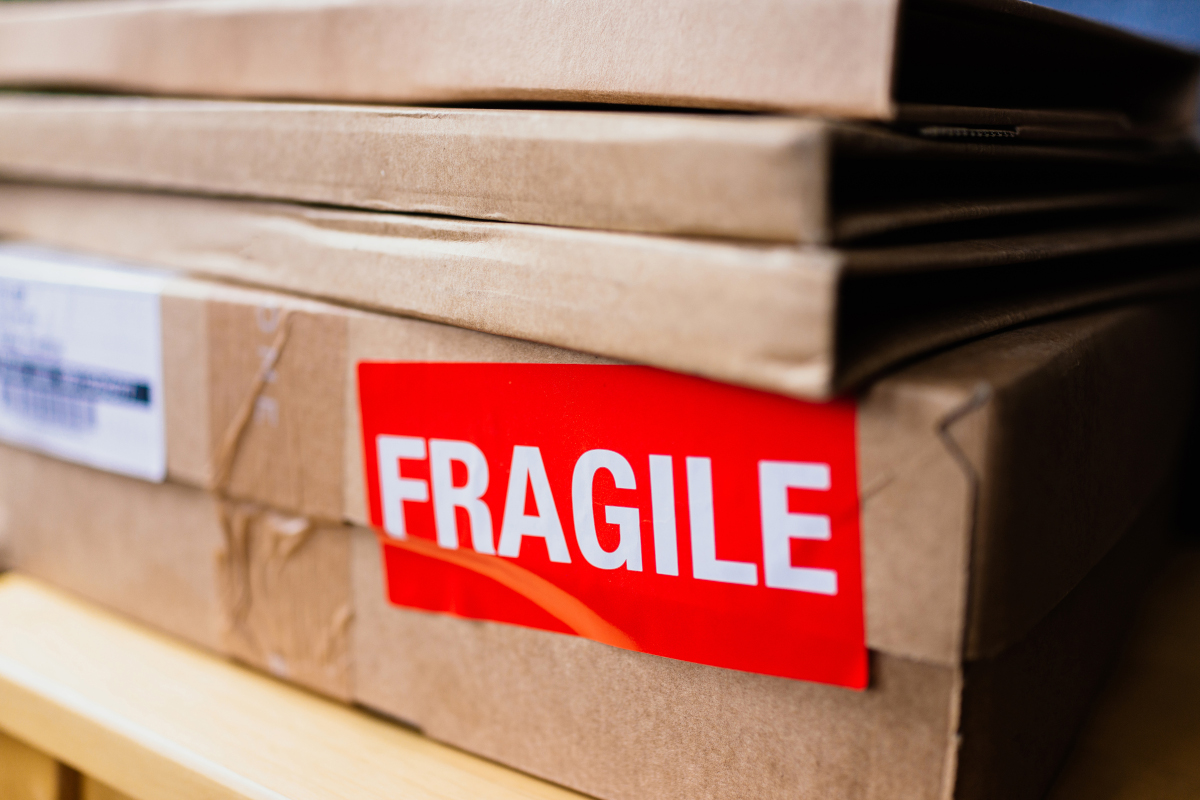
Packaging: the first level of protection
Impeccable packaging is the sine qua non condition for secure transport. It is not merely about wrapping the work in bubble wrap, but about designing a protection system tailored to each piece.
Materials to favor (and those to avoid)
For photographic surfaces, only neutral and non-abrasive materials should be used. Acid-free tissue paper, non-woven fabric (like Tyvek), and closed-cell polyethylene foams are industry standards. Conversely, standard bubble wrap can leave raised imprints on certain finishes, and corrugated cardboard sometimes contains acids that can migrate to the support if contact is prolonged.
For framed works with glass, a protective tape (such as masking tape or special film) is applied directly to the glass in a grid pattern: in case of breakage, it keeps the shards in place and protects the work underneath.
Custom crates: a necessity for valuable works
For any work of significant value, a custom crate is the reference solution. It is generally made of plywood or MDF, with an inner layer of polyethylene foam cut to the exact dimensions of the work, plus a safety margin. The internal padding must be designed to hold the work without excessive pressure while preventing it from moving during vibrations and shocks.
Climate-controlled crates, equipped with passive thermal and hygrometric regulation systems (silica gel, insulating panels), are used for particularly sensitive works or for long-distance journeys.
Protection of corners and points of fragility
Corners are statistically the most exposed areas during transport. Rigid foam or thick cardboard corner reinforcements should always be used. For framed works, corner protectors (corner guards) are an essential protection.
Logistical constraints specific to photographic transport
Beyond packaging, the transport itself is subject to constraints that non-specialized operators rarely master.
Choosing the mode of transport
For short distances, road transport in a dedicated vehicle remains the safest solution, provided that the vehicle’s suspension is suitable and that the works are not loaded with other goods. For long distances or international shipments, air transport in dedicated freight is often preferred for its speed and reduced exposure time to logistical risks.
Maritime transport, however economical, is generally discouraged for photographic works due to long transit times and ambient humidity in ship holds.
Traceability and documentation
Every transport of photographic works must be accompanied by precise documentation: condition of the conservation location, dimensions, weight, nature of the support, insured value. A condition report before and after transport, ideally conducted by a third party, allows for the identification of any damage incurred during the journey and to assert one’s rights with insurers.
Customs formalities for international transport
The temporary or permanent export of works of art is subject to customs regulations that vary by country. In France, works valued over 15,000 euros require an export certificate issued by the Ministry of Culture to leave the European space. For movements within the European Union, specific forms may be required depending on the nature and value of the pieces.
A specialized carrier generally has expertise in customs formalities and can assist clients with these procedures.
Managing deliveries to galleries or institutions
Deliveries to galleries or exhibition spaces present their own constraints: often limited access, strict schedules, and reception staff who are not always trained in handling works of art. Anticipating these constraints in advance, coordinating with on-site teams, and planning a post-delivery debriefing are part of the services that a specialized operator naturally incorporates into their offering.
Why hire a specialized art transport company?
The question may seem rhetorical, but it deserves to be asked clearly. After all, can’t a careful general carrier suffice?
Technical expertise that makes a difference
A specialist in art transport possesses skills that general carriers simply do not have: knowledge of packaging materials, mastery of padding techniques, familiarity with condition report procedures, and understanding of customs regulations applicable to works of art. This expertise is concretely reflected in how works are packaged, loaded, moved, and delivered.
Vehicles and equipment suited for the task
Specialized carriers have vehicles equipped with active suspension systems, variable-level loading platforms, and, in some cases, climate-controlled compartments. These features are not a luxury: they represent an investment justified by the nature of the works being transported.
Specific insurance coverage
Insurance is an aspect often overlooked until a loss occurs. The insurance of general carriers rarely covers works of art at their true value. Specialized operators offer tailored policies that cover works at their market value throughout the transport duration, including temporary storage phases.
To discover professional solutions tailored for the transport of photographic works and sensitive objects, you can consult Moviiu, specialist in secure art transport, which supports photographers, galleries, and collectors in all their movements.
A single point of contact for complex projects
For a traveling exhibition, a collection move, or a museum loan, having a single point of contact capable of managing the entire logistics chain, from packaging to delivery, including customs formalities and insurance, is a considerable asset. This simplifies coordination, reduces risks associated with transfers of responsibility between multiple providers, and offers complete traceability.
Transport and conservation: two inseparable concepts
Successful transport is not limited to the physical movement of a work from point A to point B. It is part of a broader logic of preventive conservation.
The state of conservation before and after transport
Every transport operation should begin with a detailed condition report of the work, conducted under suitable lighting and documented photographically. This report serves as a reference for assessing the condition upon delivery and detecting any damage, however minor, that occurred during the journey.
The acclimatization period
When a work is moved from one climate to another, it is recommended to allow for an acclimatization period before opening or unpacking it. This precaution avoids condensation phenomena and allows the support to gradually stabilize in the new ambient conditions.
Archiving logistical data
For collectors and institutions, keeping a precise record of the conditions of each transport (temperature, humidity, duration, any incidents) contributes to building a conservation history that can be invaluable for estimating the work’s value or in case of loss.
Practical advice according to profiles
For photographers
If you are shipping your own prints to clients, galleries, or exhibitions, invest in quality packaging materials: rigid tubes or trays for large formats, double-walled cartons with corner guards for framed works. For valuable shipments or unique pieces, always engage a professional.
For galleries
Galleries manage regular flows of works between exhibitions, deposits, and sales. Establishing a partnership with a specialized carrier allows for a coherent service, negotiated rates, and appropriate insurance. Training internal teams in basic handling techniques is also a worthwhile investment.
For collectors
A collector acquiring a valuable photograph must anticipate transport conditions from the moment of purchase. Negotiate with the seller or gallery the terms of packaging and shipping, and require insurance covering the work during transport. For major pieces, appoint a specialized carrier yourself rather than relying on the gallery’s arrangements.